Abstract
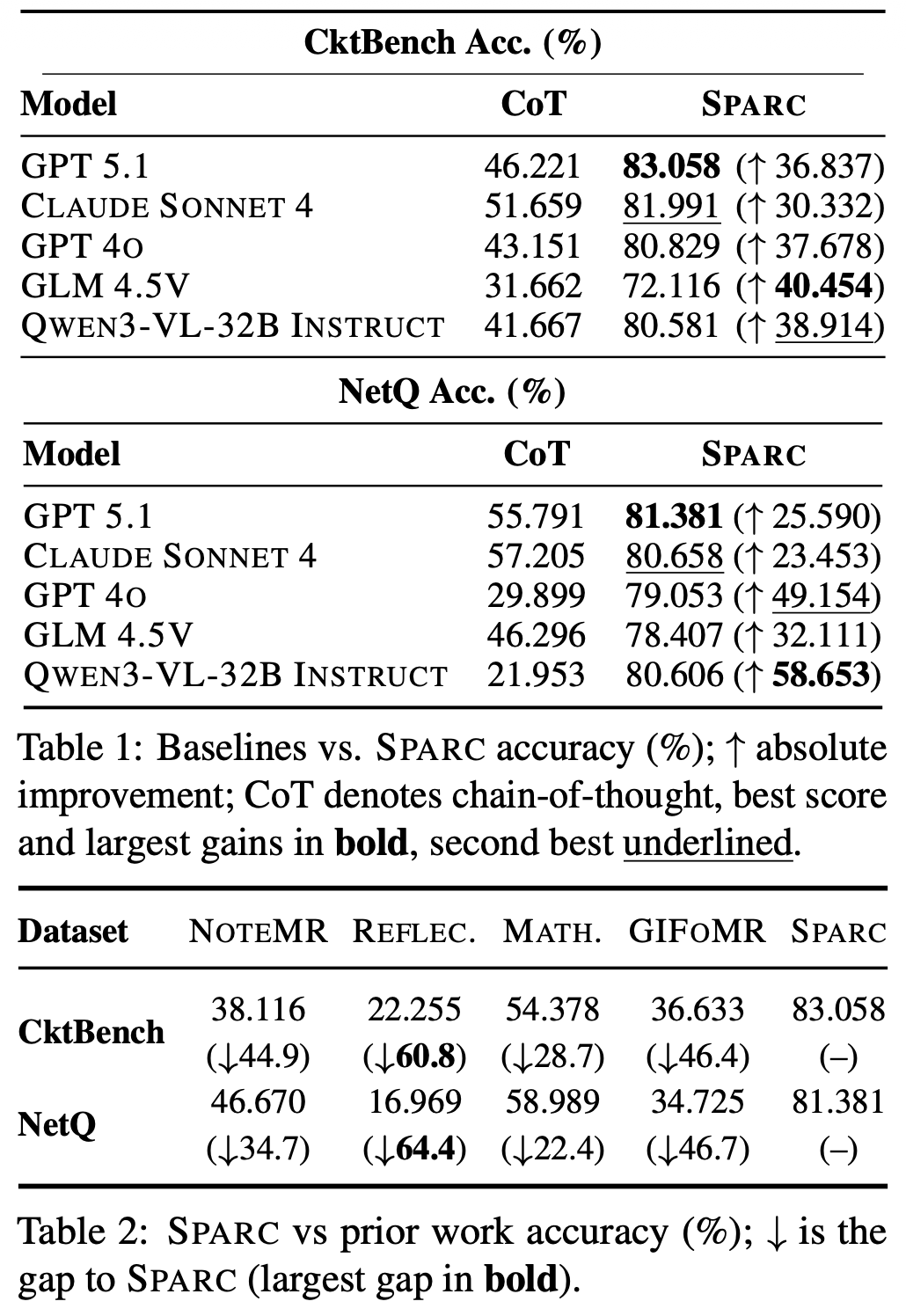
Electrical circuit diagram QA tasks require complex mathematical reasoning, which remains challenging for multimodal LLMs. We present SPARC, a multi-agent system that answers questions over circuit diagrams by grounding reasoning in executable physics-based simulations. SPARC uses LLM agents to synthesize, execute, and analyze simulation programs, improving accuracy and reliability by design. It achieves 83% accuracy, with up to a 58% absolute improvement over baselines, while enabling systematic error diagnosis.
Challenges in circuit QA
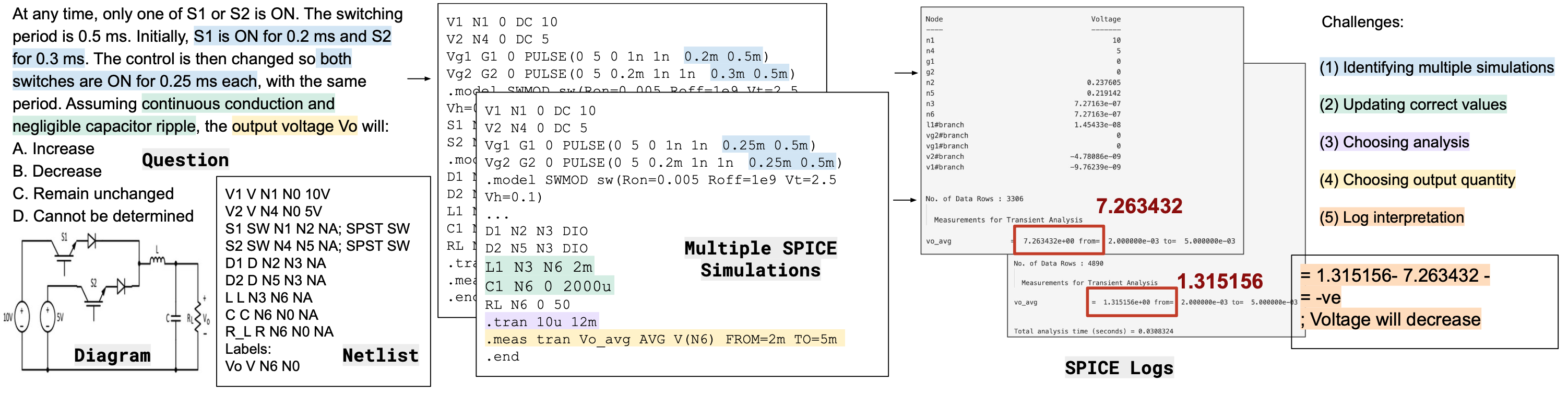
Challenges in circuit QA with SPICE: Given a diagram, a netlist and a question, the system must (1) determine number of simulations required; (2) construct or update a SPICE program with correct component values, possibly inferred from text; (3) select analyses (4) select measurements; and (5) interpret outputs to produce answer.
SPARC System Overview
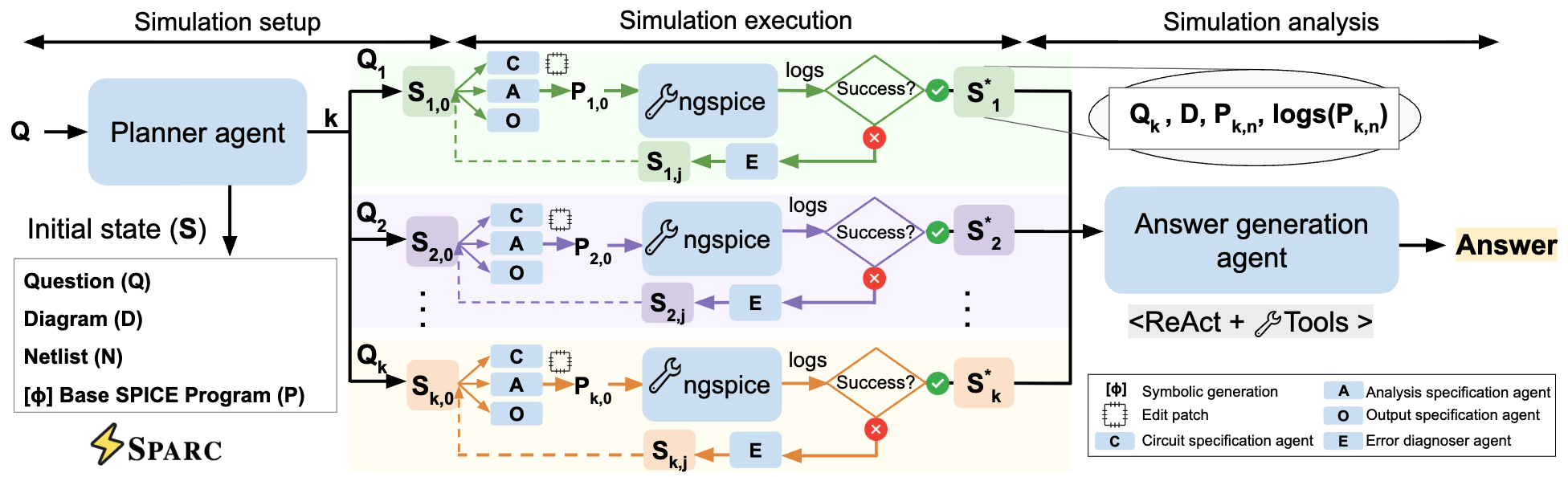
In the simulation setup stage, the planner agent constructs an initial state
\( \textsf{S} \) containing the circuit diagram \( D \), a netlist \( N \), a natural-language
question \( Q \), and a base SPICE program \( P_{0} \), then analyzes \( Q \) to determine the
number of simulations \( k \), producing simulation-specific states \( \{\textsf{S}_{i,0}\} \).
In the simulation execution stage, each simulation proceeds independently by
iteratively constructing an executable SPICE program \( P_{i} \) through patch generation and
repair using three agents, followed by execution with ngspice (an open-source SPICE
circuit simulator) and updating the state with output logs from \( P_{i} \). Upon successful
execution of all simulations (denoted by \( \textsf{S}^{*}_{i} \)), the
simulation analysis stage post-processes the \( k \) simulation outputs to derive
the final answer.
Key Contributions:
- We introduce SPARC, a multi-agent system for electrical circuit QA that synthesizes, executes, and analyzes SPICE programs, grounding LLM reasoning in physics-based simulations and enabling reliability through verifiable computation.
- We augment existing benchmarks and introduce two datasets pairing circuit diagrams with complex question–answer pairs requiring mathematical analysis, including manual netlist annotation and an automated QA generation pipeline.
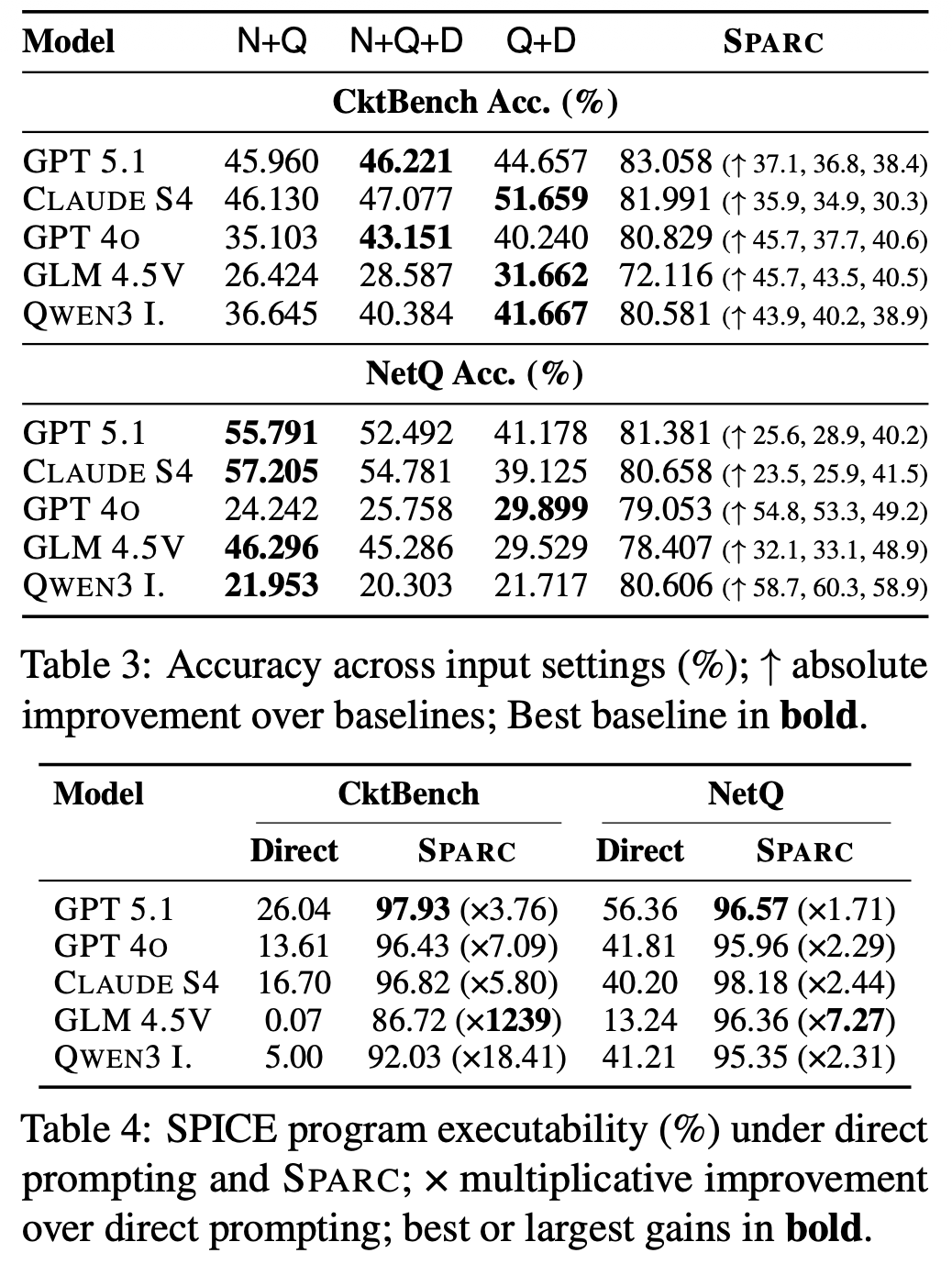
- We show through extensive experiments that SPARC achieves 83% accuracy and up to 58% absolute improvement over baselines. Notably, it delivers the largest gains for weaker models, demonstrating how SPARC's design narrows the gap to stronger models.
- We further improve reliability by introducing a structured error taxonomy that localizes failures to specific pipeline stages, enabling systematic diagnosis and interpretability.
Results
Conclusions
We have presented SPARC, a system that answers electrical circuit questions by grounding reasoning in executable, physics-based simulations. Its execution-guided design yields higher accuracy and reliability than end-to-end LLM baselines, demonstrating the effectiveness of simulator-native reasoning for complex circuit QA.
BibTeX
@misc{sadia2026sparcmultiagentelectricalcircuit,
      title={SPARC: A Multi-Agent System for Electrical Circuit Question Answering},
      author={Mushtari Sadia and Zhenning Yang and Umme Habiba Lamia and Nishat Shawrin and Ang Chen and Amrita Roy Chowdhury},
      year={2026},
      eprint={2606.20643},
      archivePrefix={arXiv},
      primaryClass={cs.AI},
      url={https://arxiv.org/abs/2606.20643},
}